
Donald McIntyre



Content note: This post discusses suicide, mental health struggles, and grief.
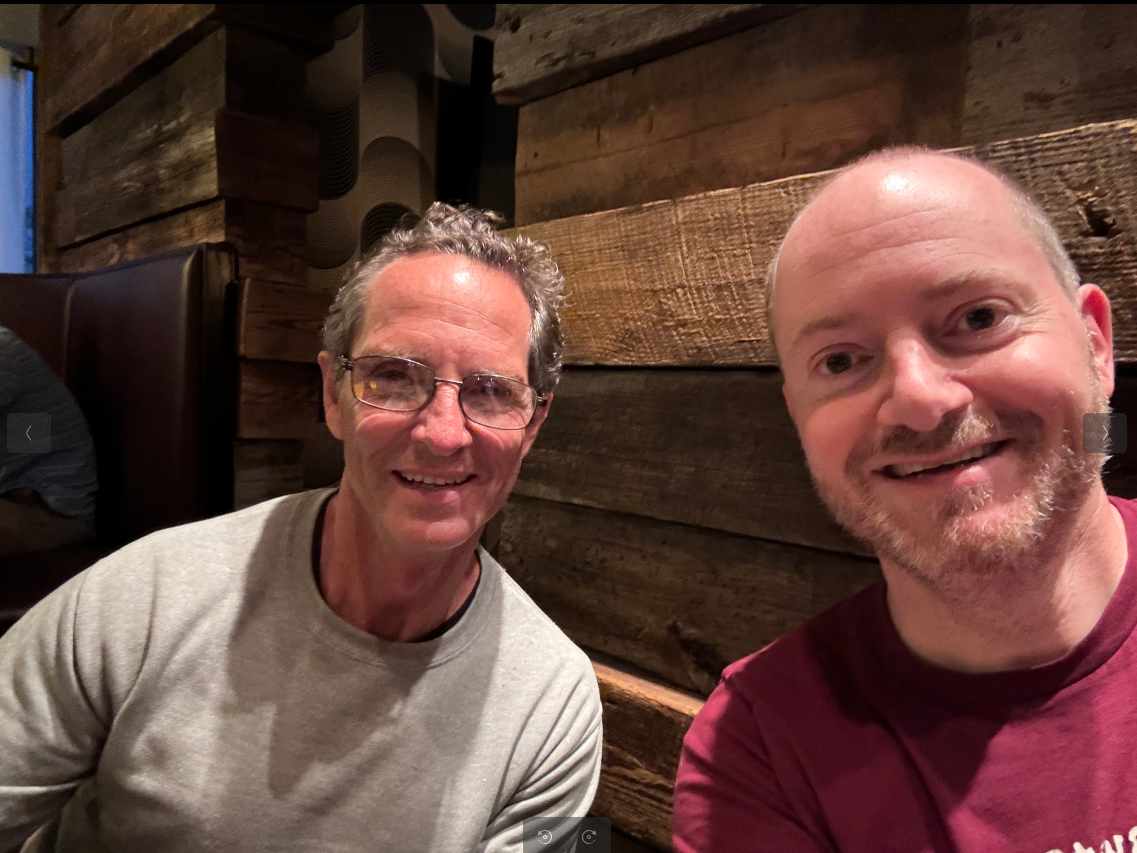
(Donald McIntyre and Bob Summerwill, at dinner during Bitcoin Conference in Nashville, July 2024)
My dear friend and long-time former colleague, Donald McIntyre, committed suicide on 2nd November 2025 in Edmond, Oklahoma.
Here is Donald’s Memorial Website, where you can leave your condolences, upload photos or videos and record memories you have of Donald, to share with his friends and family.
Donald was living alone in a trailer on a remote piece of land, having, over the years, repeatedly severed family and social connections. He had even left the local church which was his primary social forum after finding his Christian faith in 2021, following many years as an atheist.
Donald yearned for belonging, but was never able to find it in a lasting way. He isolated himself from the world. As he perceived it, he was broke, with few job prospects, alone, and living in a fearful and desperate state with no hope for a better future.
I attended Donald’s funeral in Denver last weekend, where I got to meet his wonderful family for the first time. We all spent many hours together talking through our respective lives with Donald. I was able to get a deeper picture of the highs and lows of this remarkable man, who I shall miss immensely. We all loved Donald, through the ups and downs. His family made immense efforts to support him through decades of difficult times.
If you have struggled with suicidal thoughts yourself, some of what follows may feel uncomfortably familiar.
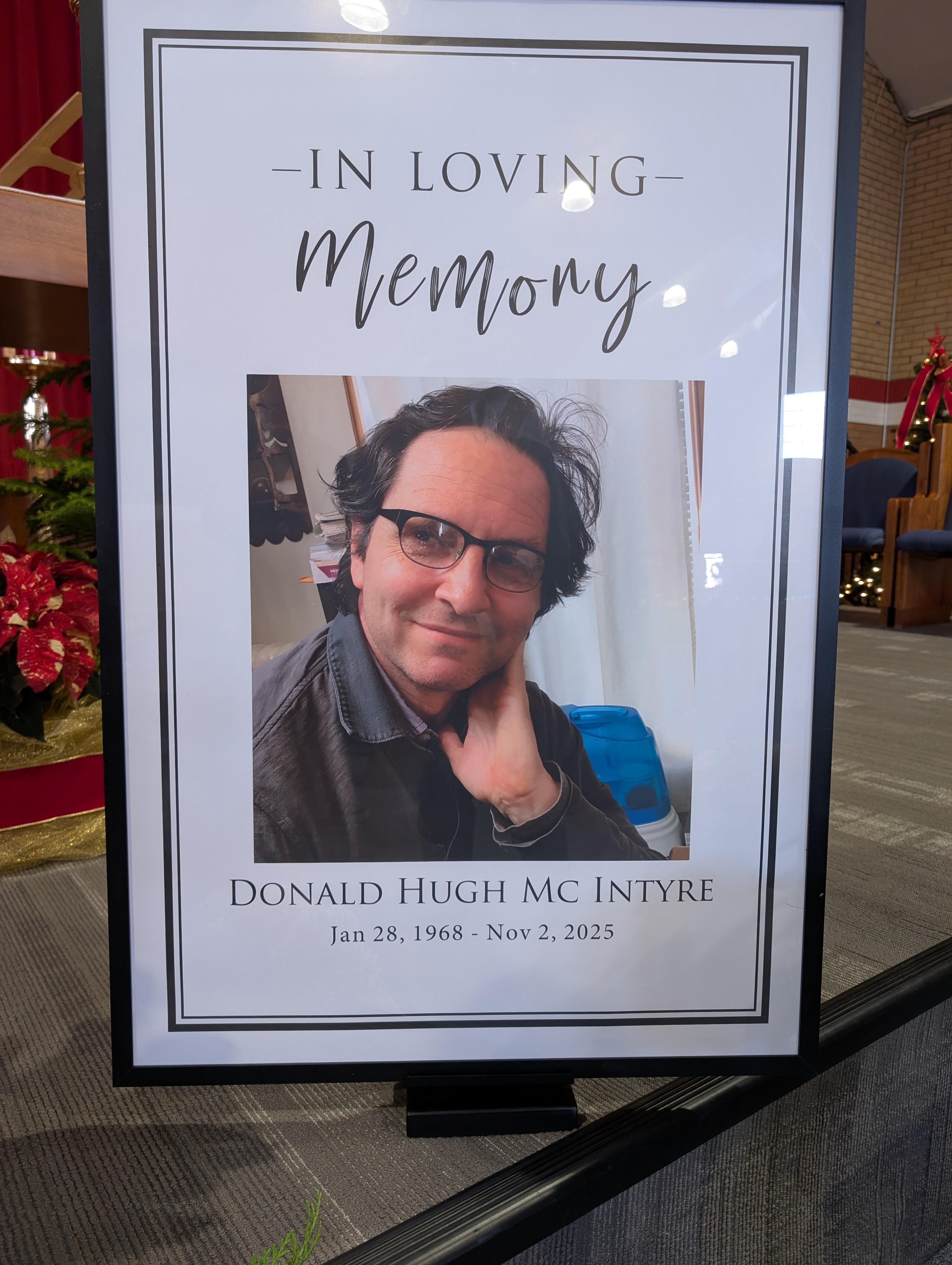 (Photo frame from Donald ‘s Memorial Mass in Denver, 20th December 2025)
Donald was never boring, in all the good and all the bad ways!
Donald had great success in his early life, which I did not personally witness, but which you can read about in the official obituary written by his sister Monica.
I first met him online in around 2016 and over the years we built a solid personal friendship in addition to our professional collaboration in the cryptocurrency space, and especially around the Ethereum Classic project. I spent time with Donald across multiple conferences from 2018 onwards in Seoul, Vancouver, Prague, Nashville and Frankfurt. He was often a keynote speaker.
He was a deep thinker and a prolific writer. He particularly admired the writings and work of Nick Szabo, a well-known figure in the early history of blockchain technology. They became business partners and friends. Nick mentioned Donald by name in his keynote talk at the first Ethereum developer conference in London in 2015.
Donald was extraordinarily prolific. He appeared in dozens of recorded talks and interviews, published hundreds of articles through Etherplan and the Ethereum Classic website, and remained deeply engaged in public discourse for years.
His work and public appearances include:
- Playlist of 31 videos featuring Donald
- Another 108 videos on his Etherplan channel
- Hundreds of articles on his Etherplan website
- Numerous articles on ethereumclassic.org
- Numerous articles on etccooperative.org
His loss has hit me hard because I have also had long spells of suicidal ideation myself, with my own suicide attempts in 2014 and 2016. I know what it is like to suffer from long-lasting mental health challenges while being in the public eye. I felt deep empathy for Donald and I did everything which I could to help him through his tough times, and in return he always had my back.
Behind the spiky public persona was an exceptionally kind, considerate and thoughtful guy. Shy and nervous, even! Many people did not get to see that side of Donald online, but it was very evident in person at conferences. Many people said ” He’s so nice - not what I expected!”
 (Andrew Dick, Donald McIntyre and Angelah Li, collectively forming the ETC Cooperative Marketing team, at POW Summit in Prague, October 2023)
I am not a clinician but I do have a lot of personal experience around people with mental health issues, starting with myself. Over the years, I observed in Donald many patterns commonly associated with Borderline Personality Disorder, which may help contextualize the frequent online “blow-ups” and “rage-quits”. He cycled through many, many Twitter accounts, either being banned or quitting and then returning.
“Borderline personality disorder is a mental health condition that affects the way people feel about themselves and others, making it hard to function in everyday life. It includes a pattern of unstable, intense relationships, as well as impulsiveness and an unhealthy way of seeing themselves. Impulsiveness involves having extreme emotions and acting or doing things without thinking about them first. “ - Mayo Clinic
It is a miserable condition, with such personal fear of loss or rejection that the sufferer will often choose to sever these most valued connections themselves at the least threat, to retain at least some sense of control in their self-sabotage. I saw this behavior repeatedly in Donald.
Why do people commit suicide? Why might certain individuals take that final step while others do not? Most people who have not experienced the depths of misery that can lead an individual toward suicide find it very hard to understand, let alone to empathize.
I was recently introduced to the Interpersonal Theory of Suicide, developed by Thomas Joiner, which I have found to be very useful as a framework to better understand suicide. There is no formulaic playbook or single cause for suicide, but this framework has helped me better understand some of the forces at play. I do not claim that this explains Donald’s death, nor that suicide ever follows a single path.
” The theory consists of three components that together lead to suicide attempts. According to the theory, the simultaneous presence of thwarted belongingness and perceived burdensomeness produce the desire for suicide. While the desire for suicide is necessary, it alone will not result in death by suicide. Rather, Joiner asserts that one must also have acquired capability (that is, the acquired ability) to overcome one’s natural fear of death.”
Donald had struggled with personal connection for many years, with his Borderline behavior leading him to repeatedly break connections with close friends, with his wife and with the rest of his family.
He had suffered inconsistent employment and money issues for many years in consequence of his blow-ups and rage-quits. His family life was also frequently disrupted. These factors clearly fed into his sense of feeling that he was a burden on others. He said so explicitly in his final note.
We are born with an innate sense of self-preservation, meaning that it is an acquired capability which dulls our innate instinct for self-preservation. For Donald this was the last in a series of many suicide attempts, going back over sixteen years. He had become dulled to the fear of self-harm.
When he came to the end of the road and was in the depth of his despair, he could proceed with self-harm where others could not take that final step. I myself faltered at this point. Twice. But I remember very clearly quite how emotionally numb I felt at that point. I was actually disappointed in myself that I could not do it.
Social media was also a major factor for Donald, having been problematic for him for many years. Algorithms optimize for engagement and outrage, and Donald was easily triggered. At their worst, these are addiction machines. He was feeding himself miserable stories, day after day, for hours on end.
In retrospect it is easy to see his descent in the last few months with everything being “dead”, “fallen”, “demonic” or “Satanic”. His new found faith, which at first made him humble, had seemingly turned into harsh certainty and literal preparation for the End Times. He was stockpiling prepping supplies and ammunition. He spoke of his land as a “refuge” to multiple people and said to one friend “From here in Oklahoma we can fight whatever comes”. It was a tragic ending.
Why am I writing all of this? Because there is still a huge stigma around suicide, which is hugely harmful to people who find themselves in a suicidal state. Many of them are ashamed that they feel that way. That was my own situation. I did not tell my own wife about my suicide attempts until nearly four years later, because I was afraid that she would take my children away from me.
Many people will not reach out for the help that they desperately need. Do not feel they can talk about it. They fear being seen as weak or even as willfully selfish. This is especially the case for men. There is an epidemic of loneliness and disconnection for many of us. Donald never sought help. He never even acknowledged he had a problem.
Know that you are not alone. Please do reach out for help. However desperate you may feel, know that there are people who love you.
If you think that it would be helpful to talk to me then please feel free to contact me anytime, irrespective of whether we have even had any prior contact. This is an ongoing open offer to the world, which I have made multiple times over the years.
Here are some resources if you or someone you know is struggling. Free and confidential help is available in many countries — by phone, text, or online chat
United States
• 988 Suicide & Crisis Lifeline — call or text 988 , or chat at 988lifeline.org
United Kingdom & Republic of Ireland
• Samaritans — call 116 123 or visit samaritans.org
Canada
• Talk Suicide Canada — call 1-833-456-4566 or visit talksuicide.ca
Australia
• Lifeline — call 13 11 14 or visit lifeline.org.au
Worldwide
• Befrienders Worldwide / Find a Helpline — findahelpline.com
• IASP (International Association for Suicide Prevention) —https://www.iasp.info/crisis-centres-helplines/
If you are in immediate danger, please contact your local emergency number.